Why Choose Custom Wiring Harness Fabrication?
Custom wiring harness fabrication offers a practical way to match electrical systems with real operating conditions. Standard harnesses may fit common designs, but they often leave unused connectors, crowded branches, or excessive cable length. A custom harness can follow the exact route through a machine, vehicle, or control cabinet. It can also support selected terminals, shielding, labels, and protective sleeving.
Experienced fabricators begin with more than a schematic. They review current ratings, voltage levels, bend radius, heat exposure, vibration, and service access. A harness passing beside an engine needs different protection from one installed inside a clean instrument panel. Careful cutting, stripping, crimping, and testing help reduce loose connections and intermittent faults. Every terminal should receive appropriate pull testing or inspection. Small details matter.
The process is not automatically perfect. A rushed measurement can still create an expensive rework problem. Sometimes an early prototype reveals that a connector is difficult to reach, even when the drawing appears correct. That feedback should improve the next revision. Reliable wiring harness fabrication combines engineering judgment, controlled production, and documented quality checks. It gives manufacturers better consistency while supporting maintenance teams in the field. Clear labels can save minutes during service, and minutes often matter. When a harness fits the application from the beginning, installation becomes cleaner, troubleshooting becomes more direct, and long-term reliability becomes easier to manage.
What Is Custom Wiring Harness Fabrication?
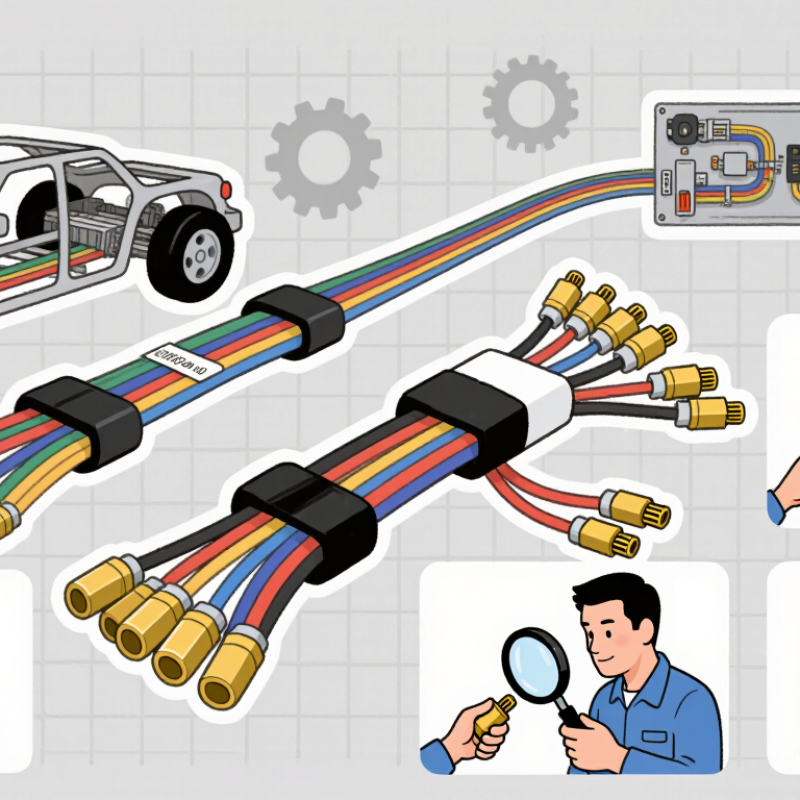
Custom wiring harness fabrication creates a cable assembly for a specific machine, vehicle, or control system. It combines wires, terminals, connectors, sleeving, labels, and retention parts. Engineers match the harness to available space, electrical load, movement, and environmental conditions. Standard cables may not fit unusual layouts. A custom harness provides controlled connections.
Not merely bundled wire.
Fabrication begins with a wiring diagram, interface list, and physical measurements. Technicians cut wires to defined lengths and strip insulation carefully. They attach terminals with controlled crimp pressure. Each branch is routed on a fixture matching the final assembly. This exposes tight bends, blocked connector access, or weak strain relief.
I have found that drawings can look complete. The first sample may reveal an awkward service path. That discovery is useful. Ignoring it is not.
Reliable fabrication includes continuity checks, pin-to-pin verification, insulation testing, and visual inspection. Test records improve traceability and help identify repeated defects. Materials should suit heat, vibration, moisture, and chemical exposure. Clear labels can reduce repair time. Small details matter. However, custom work is not automatically better. Poor measurements or rushed revisions can create expensive rework. Reviewing prototypes with installers and maintenance staff often reveals practical improvements before production begins.
Which Applications Benefit from Custom Wiring Harnesses?
Custom wiring harnesses benefit applications where standard cables cannot provide a reliable fit, routing path, or connection layout. They are widely used in vehicles, industrial machinery, robotics, medical equipment, and control cabinets. Each application has different space, temperature, vibration, and signal requirements. A harness designed for a compact machine can keep wires away from moving parts and reduce installation time. Fit matters.
In industrial automation, custom harnesses support sensors, motors, valves, and control units with clear labeling and organized branches. In medical equipment, careful material selection and secure connections help support consistent operation during repeated cleaning and handling. Transportation systems may require abrasion-resistant coverings, locking connectors, and protection from moisture. Signal quality matters too. Separating power and communication lines can reduce interference. However, a custom design is not automatically better. Poor drawings, rushed testing, or incorrect wire sizing can create expensive faults. That point is easy to overlook.
Tips: Start with a complete application review. Record current, voltage, temperature, bend radius, connector positions, and service access. Use prototypes to check real-world fit before full production. Test continuity, insulation, pull strength, and routing clearance. Keep revision records, because a small pin change can affect the entire assembly. A harness should be easy to install, inspect, and replace. That is sometimes forgotten.
How Is a Custom Wiring Harness Designed?
A custom wiring harness is designed from the application outward, not from a standard bundle inward. Engineers begin by documenting voltage, current, signal type, temperature, moisture, vibration, and available space. The harness layout then follows the equipment’s real geometry. Wire lengths, branch points, connector positions, and bend radii are recorded carefully. Practical experience matters here. A harness may look correct on a screen but fail near a sharp bracket or hot surface.
The design usually starts with a circuit diagram and a pin-to-pin connection list. Engineers select wire gauges, insulation materials, terminals, seals, and protective sleeving for each circuit. They also define routing paths and service access. Prototypes can reveal problems that calculations miss. A connector may be difficult to reach. A branch may pull against another cable. These details deserve honest review. Not every first design is perfect, and that is normal. Testing should include continuity, resistance, insulation integrity, terminal retention, and visual inspection. Clear drawings and controlled revision records improve reliability during fabrication and future maintenance.
Tips: Leave room for movement, inspection, and repairs. Label both ends of each circuit. Avoid forcing tight bends. Check actual installation conditions, not only laboratory measurements. Have another qualified person review the pinout; a small overlooked error can affect the entire system.
Why Choose Custom Wiring Harness Fabrication?
How Is a Custom Wiring Harness Designed?
Conductor size is selected according to current, circuit length, and allowable voltage drop.
This chart shows the calculated voltage drop for copper conductors carrying 10 A through a
5 m one-way circuit, using standard conductor resistance values at 20°C. Larger conductors
reduce voltage loss and can improve the reliability of a custom wiring harness.
What Materials and Components Are Used?
Why Choose Custom Wiring Harness Fabrication?
What Materials and Components Are Used?
Custom wiring harness fabrication depends on careful material selection. Copper conductors provide excellent conductivity and flexibility for most equipment. Tinned copper adds corrosion resistance in humid or marine environments. Aluminum can reduce weight, but it requires careful termination design. The insulation matters too. PVC is practical and economical, while silicone handles heat and repeated movement better. TPE offers a useful balance between flexibility, durability, and chemical resistance.
A reliable harness may include terminals, connectors, seals, clips, fuses, relays, braided sleeving, and strain reliefs. Each component should match the current, voltage, temperature, and vibration demands. Poorly matched terminals can loosen over time. That detail is easy to miss. During fabrication, technicians typically crimp, route, label, and test each circuit. Continuity testing, pull testing, and insulation checks help reveal hidden weaknesses. However, no material choice is perfect. Early prototypes sometimes expose assumptions about bend radius or installation space.
Tips: Specify the operating temperature and moisture exposure before choosing insulation. Measure the required cable length twice. Leave controlled slack near moving joints. Use clear labels and documented pin layouts. A small design review can prevent expensive rework. Safety margins should be practical, not excessive.
How Does Custom Fabrication Improve System Performance?
Custom wiring harness fabrication improves system performance by matching the harness to the equipment, not forcing equipment around a standard cable set. Engineers can select exact wire gauges, conductor lengths, insulation materials, and connector positions. This reduces excess loops, sharp bends, and unnecessary junctions inside crowded enclosures. Small details matter.
In field installations, shorter power paths can reduce voltage drop and limit heat buildup. Proper shielding and controlled routing can also protect sensitive signals from electrical noise. A carefully designed harness supports stable data transmission, cleaner sensor readings, and more predictable machine operation. Labels and color coding make inspection faster. Technicians can trace faults without dismantling the entire system.
Custom fabrication also allows terminals, seals, strain reliefs, and branch points to suit real operating conditions. A harness exposed to vibration needs different support than one installed in a dry cabinet. Production testing, including continuity checks and insulation inspection, helps catch assembly errors before installation. Yet custom work is not automatically superior. I have seen well-designed harnesses underperform because drawings were outdated or connectors were crimped inconsistently. Documentation needs attention.
Early prototypes may reveal unexpected interference, difficult access, or excessive assembly time. Those findings should change the design, even when the first version looks acceptable. Clear tolerances, inspection records, and repeatable processes make performance more reliable across production batches. A practical harness should fit securely, carry current safely, and remain understandable months after installation.