Choosing the right production equipment can shape a block business for years. A Block Forming Machine may improve output, consistency, and workplace organization. However, its value depends on your products, materials, labor, and market demand.
In real projects, manufacturers often compare cycle time, mold flexibility, vibration performance, and maintenance access. These details matter on a busy factory floor. Operators need clear controls and reliable safety features. They also need training that reflects daily working conditions, not only showroom demonstrations. A machine producing uniform blocks can reduce rejected units and simplify quality checks. It may also support faster order fulfillment when construction demand increases.
Still, higher capacity is not always the best choice. No machine solves every problem. A larger model can increase energy use, space requirements, and repair costs. That assumption can be costly. Buyers should review technical data, test local aggregates, and request documented performance evidence. They should also confirm after-sales service, spare-parts availability, warranty terms, and compliance with applicable standards.
A practical evaluation begins with honest numbers. Estimate daily production, labor costs, mold changes, curing space, and expected downtime. Speak with experienced operators and verified suppliers. Their answers may reveal limitations that brochures overlook. The best investment is not simply the fastest machine. It is the equipment that delivers dependable quality, manageable costs, and room for responsible growth. Careful planning helps turn automation into a reliable business advantage.
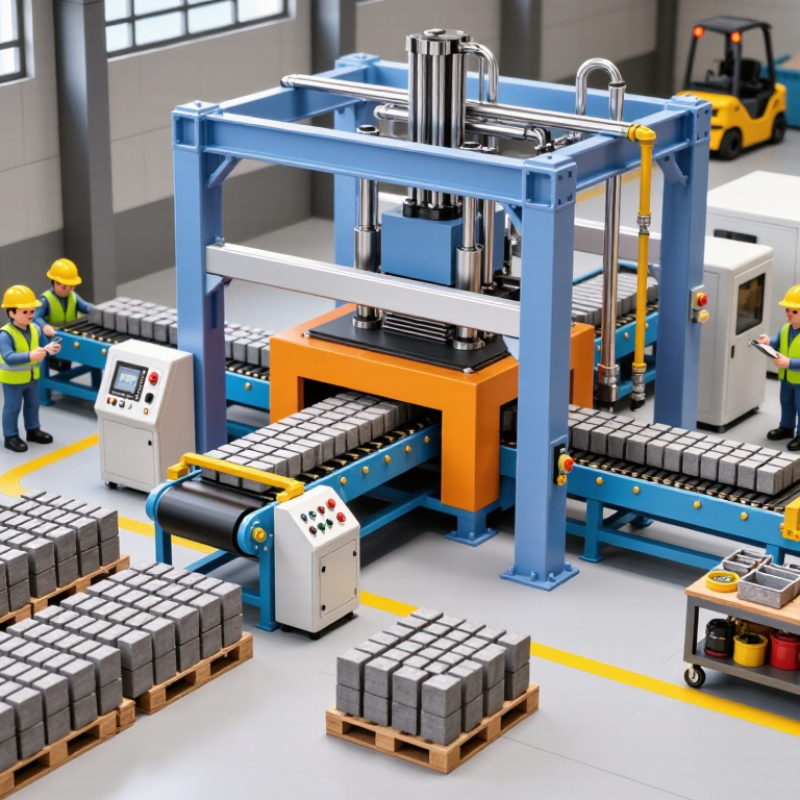
A block forming machine is industrial equipment that converts measured concrete into uniform masonry units.
Its core cycle includes batching, mixing, feeding, vibration, compression, and demolding. The mold controls each block’s dimensions and surface profile. Vibration reduces trapped air, while pressure stabilizes the fresh unit. Operators can produce hollow blocks, solid blocks, paving units, or customized shapes by changing molds.
The machine is not simply a concrete mixer. It is a forming system that improves repeatability after mixing.
A machine’s business value depends on cycle time, mold-change speed, compaction quality, and curing arrangements.
Production claims need caution. Actual output changes with block size, concrete moisture, operator skill, and downtime. During plant testing, measure acceptable blocks per hour, not only advertised capacity.
The United Nations Environment Programme reported in its 2023 Global Status Report that buildings and construction consumed 34% of global energy and generated 37% of energy- and process-related emissions.
This report does not measure block machines directly, but it shows why efficient batching and lower rejection rates matter.
Tips:
Request a sample run with local aggregates. Record moisture, cycle time, rejection rate, power use, and mold-change minutes. Check compressive strength against the applicable standard, such as ASTM C90 where relevant. Leave room for error. Real plants are rarely perfectly balanced. A machine may look efficient until curing space, maintenance delays, and inconsistent raw materials expose the gaps.

The process is repetitive, but not automatic perfection. A small moisture change can create weak edges or rough surfaces. Experienced operators check slump, aggregate grading, mold alignment, and vibration time during each production shift. ASTM C90 and ASTM C140 provide useful benchmarks for load-bearing units and test procedures. These standards help connect factory control with jobsite performance.
This matters in a large construction market. The International Energy Agency reports global cement production at roughly 4.1 billion tonnes annually. UNEP’s 2023 Global Status Report states that buildings and construction generated about 37% of global energy-related and process emissions in 2022. Better batching can reduce rejected blocks and unnecessary material use. Still, faster production does not automatically mean lower impact. Electricity demand, curing methods, cement content, and local transport must be measured honestly. A reliable machine is valuable because it makes quality more repeatable, not because it removes the need for judgment.
A block forming machine can turn a small production area into a more predictable operation. It standardizes pressure, dimensions, and cycle timing. This reduces dependence on manual shaping and supports consistent output for contractors. Consistency matters when walls must align across hundreds of units.
The business case is measurable. The 2024 Global Status Report for Buildings and Construction states that buildings and construction used about 32% of global energy in 2022. It also produced around 34% of global energy-related emissions. A modern forming machine cannot solve this sector-wide problem. However, accurate batching and controlled compaction can reduce rejected blocks, wasted cement, and unnecessary rework. Every avoided batch protects material costs. It also reduces disposal pressure.
Market demand offers another reason to consider the equipment. Grand View Research’s 2024 concrete blocks market analysis projects continued growth through 2030, supported by urban development and infrastructure spending. A machine helps businesses respond with repeatable production instead of adding labor alone. It can support several mold designs, allowing sales teams to serve different projects. That flexibility has value.
Still, automation is not an instant profit button. Electricity, mold maintenance, operator training, and site preparation require serious budgeting. A poorly maintained machine may create faster waste. Production records should track cycle time, rejected units, cement use, and labor hours before expansion. The numbers may challenge initial expectations. That is useful.
A block forming machine should match your daily production needs, not just its advertised output. Start with forming accuracy. A rigid frame, stable vibration, and controlled pressure help produce blocks with consistent dimensions. This matters when pallets must stack evenly and construction teams expect reliable fitting. Ask how quickly operators can change molds. Simple changeovers reduce idle hours and make smaller orders more practical.
Material flexibility is another important feature. Moisture levels and aggregate sizes can vary during production. A machine with adjustable feeding, vibration, and compression settings can handle these changes better. Automatic controls may improve repeatability, but they should remain easy to understand. Complicated screens can slow workers during a fault. Clear alarms help. Practical access helps more.
Maintenance details often decide long-term value. Look for protected electrical components, accessible lubrication points, and replaceable wear parts. Check whether technicians can inspect the mold area without unsafe lifting or awkward climbing. Energy use also deserves attention, especially during long operating shifts. A lower purchase price can become disappointing if downtime, dust buildup, or frequent adjustments reduce actual output. No machine is perfect. Operators may still need to fine-tune settings after changing materials or weather conditions. That small weakness should be included in the buying decision, not ignored.
Choosing a block forming machine starts with your production reality, not a glossy catalogue. Measure daily demand, available floor space, block dimensions, and curing capacity. A machine producing 10,000 blocks daily may sound efficient, but it becomes wasteful when your yard can cure only 6,000. Check the mix design too. Dry, semi-dry, and wetter materials require different feeding and compaction performance. Test the mix. Ask for trial blocks made with your own aggregate. That small test often reveals more than a sales presentation.
Power supply and labor conditions deserve equal attention. Confirm voltage, motor load, noise, and dust-control requirements with a qualified technician. In a hot, dusty workshop, accessible lubrication points and sealed electrical cabinets can prevent avoidable downtime. Operators should adjust molds, clear material safely, and read basic pressure or vibration indicators. Keep the controls simple. Complexity is not always progress.
Compare output at consistent cycle times, not the highest number printed in a brochure. Request records for rejected blocks, mold wear, maintenance hours, and spare-part availability. Calculate electricity, labor, cement, water, repairs, and lost production over one year. The cheapest purchase can become expensive. I would also inspect frame welds, hydraulic lines, safety guards, and emergency stops before signing. Some decisions still remain uncertain. A pilot run, documented acceptance criteria, and independent technical advice can expose weaknesses before installation.